
Bitcoin for Business Owners
Understanding Bitcoin in 2026
A balanced look at the bull case, the bear case, and what matters for Canadian business owners.
If you're an incorporated business owner or high-net-worth individual who wants to understand Bitcoin objectively, this analysis is for you. We cover why some investors view it as a hedge against currency devaluation, what's happening in markets now, the bull case, the bear case, and questions to consider.
Why the Currency Context Matters
Before discussing Bitcoin, the broader picture matters. Several forces are creating pressure on the US dollar. Because about 75% of Canadian exports go to the US, this affects the Canadian dollar too.
In our inflation and dollar devaluation analysis, we outlined six converging forces:
Quantitative easing resuming: The Fed restarted Treasury purchases in late 2025. When central banks create money faster than output grows, purchasing power tends to decline.
US debt at $38 trillion and growing: Trillions in debt mature each year. The government issues new debt to refinance. That cycle requires continued currency creation.
Central banks selling Treasuries, buying gold: Central banks bought over 1,000 tonnes of gold for three consecutive years. Gold moved from about $1,800 (early 2023) to $4,300+ (late 2025). That shift signals declining confidence in traditional reserve currencies.
Yen carry trade unwinding: Investors borrowed cheap yen to buy dollar assets. As Japan raises rates, they sell dollar assets to repay yen loans. That creates sustained selling pressure on the dollar.
Policy may favor a weaker dollar: A weaker dollar boosts US exports and reduces the real value of government debt. Some economists see this as deliberate.
The US-Canada link: Canadian business owners cannot ignore US fiscal policy. When the US dollar weakens, the Canadian dollar typically weakens too.
Together, these forces point toward continued pressure on fiat currency purchasing power. Over 20 years at 5% inflation, you lose about 62% of purchasing power. At 8%, about 79%. At 10%, about 86%. In that context, some investors explore alternatives like gold, real estate, and digital assets such as Bitcoin.
What Bitcoin Is and Why It Exists
Bitcoin was created in 2009, after the 2008 financial crisis, as a response to failures in the traditional banking system.
Decentralized: No government or central bank controls it. It runs on a distributed network of computers worldwide.
Fixed supply: Only 21 million Bitcoin will ever exist. Scarcity is enforced by mathematics, not policy.
Deflationary design: Every four years, the rate of new Bitcoin creation is cut in half. The last Bitcoin will not be mined until roughly 2140.
Security: Bitcoin uses Proof-of-Work. It requires massive computational power, which makes attack or manipulation very costly.
Censorship-resistant: Transactions cannot be blocked by governments or banks. Anyone with internet access can send or receive Bitcoin.
The "Digital Gold" Thesis
Supporters compare Bitcoin to gold because both have limited supply, cannot be created by governments, and can serve as stores of value outside the banking system.
Bitcoin differs from gold in some ways: easier to move (send millions globally in minutes), easier to divide (down to eight decimal places), easier to verify (transparent blockchain), and easier to secure when managed properly.
Bitcoin is also far more volatile than gold, lacks gold's long history, and faces unique technological and regulatory risks.
What's Happening Now: February 2026
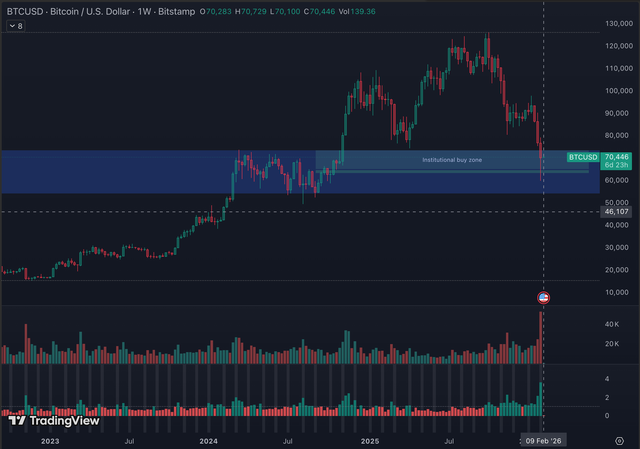
Bitcoin reached an all-time high of about $126,000 in October 2025, following the US election and pro-crypto policy announcements.
Then came a sharp sell-off. On October 10, 2025, tariffs on Chinese imports were announced. Markets sold off broadly. Bitcoin fell to a low of about $60,000 by early February 2026. That is a drop of over 50% from the peak.
As of February 2026, Bitcoin has recovered to roughly $70,000 to $71,000. It remains about 45% below its all-time high. Volatility is still high.
Why Did Bitcoin Crash Despite Pro-Crypto Policy?
Despite supportive policy (a strategic crypto reserve, crypto-friendly regulators, and new crypto ventures), Bitcoin still crashed. Several factors matter:
- Excessive leverage: Many traders borrowed heavily to buy Bitcoin. That magnified both gains and losses.
- Liquidation cascade: When prices fell, over-leveraged positions were closed automatically, accelerating the decline.
- Correlation with risk assets: Bitcoin behaves like a risk-on asset. It falls when stocks and tech fall.
- Macro headwinds: Rising rates, economic uncertainty, and trade tensions affect all markets.
Bitcoin's price is driven by many factors beyond regulatory sentiment.
The Bull Case
Institutional Adoption
Despite the crash, publicly traded companies hold over 1 million BTC in treasuries. Spot Bitcoin ETFs (approved in 2024) continue to see inflows. Major institutions are active in the space.
The Devaluation Hedge Thesis
Given the six forces above: central banks creating new currency, government debt growing, gold and other hard assets rising, Bitcoin's fixed 21 million cap stands in contrast. For those concerned about currency devaluation, Bitcoin offers mathematically guaranteed scarcity, no counterparty risk when you hold your own keys, and portability gold cannot match.
Network Effects
Bitcoin has run continuously since 2009. It has survived multiple large crashes and predictions of failure. The network is the most secure blockchain. No other cryptocurrency has matched its level of decentralization or security.
Historical Pattern
Bitcoin has had several severe crashes: 2011 (-93%), 2013 (-87%), 2017-2018 (-84%), 2021-2022 (-77%), and 2025-2026 (-52% so far). Each time, it has historically established a higher floor before the next cycle. Past performance does not guarantee future results.
The Bear Case
This section matters. Many Bitcoin articles focus only on the optimistic side. Responsible analysis requires examining the risks.
1. MicroStrategy and Corporate Treasury Risks
MicroStrategy (now called "Strategy") holds about 713,000 Bitcoin at an average cost of about $76,000 per coin. The company is roughly at breakeven. They funded purchases with stock sales and debt. Their stock trades at a discount to the value of their Bitcoin. They carry $8.2 billion in convertible debt. If they must sell Bitcoin to meet obligations, it could trigger a cascade. They have been one of the largest consistent buyers. If they stop buying or become forced sellers, that removes significant buying pressure.
2. Exchange Trust: The Binance Situation
Binance, the largest crypto exchange, has faced multiple issues: about $19 billion in liquidations in October 2025 (with traders blaming systems), a data breach exposing 420,000 credentials in January 2026, a brief withdrawal halt in February 2026, and ongoing allegations of money laundering and regulatory violations. If Binance faced insolvency (like FTX in 2022), it would devastate crypto markets. Even without insolvency, loss of trust drives withdrawals and reduced liquidity. On-chain data suggests Binance is solvent, but perception matters.
3. Regulatory Uncertainty
The CLARITY Act passed the House in July 2025 but stalled in the Senate in January 2026 when Coinbase's CEO withdrew support. The sticking point is whether exchanges can offer yield on stablecoins. Banking lobbyists oppose crypto competition. Prolonged uncertainty keeps institutional investors cautious. If the bill fails, regulation-by-enforcement returns, which could lead to exchange shutdowns or fines.
4. Market Structure Concerns
Market depth has not fully recovered since the October crash. Wider spreads and weaker order books make large sells more impactful. Leverage in futures markets remains high. Another deleveraging could drive prices lower. Bitcoin continues to move with tech stocks. A broader stock correction could pull Bitcoin down further.
5. Downside Price Targets
Several analysts suggest Bitcoin could test $50,000 to $60,000, or $40,000 to $50,000 if support breaks. In extreme scenarios (exchange failures, major regulatory crackdowns), prices could go lower.
6. Fundamental Questions
Can another cryptocurrency overtake Bitcoin? Ethereum, Solana, and others offer different features. If developers and users migrate, Bitcoin's dominance could erode.
Can it be banned? Governments cannot shut down the protocol, but they can make it very hard to use by banning exchanges, criminalizing possession, or imposing harsh tax treatment. That has not happened in major economies yet, but it remains a risk.
Is adoption growing beyond speculation? Institutional money has entered, but usage as an actual currency remains limited. If Bitcoin does not show real-world utility beyond speculation, long-term value could be questioned.
What Shape Might Recovery Take?
V-shaped recovery: Unlikely in the near term. Liquidations created a liquidity void. Market depth has not recovered. Institutional appetite is cautious. Regulatory uncertainty, exchange trust issues, and macro conditions add headwinds.
Extended consolidation or double bottom: More plausible. Bitcoin may trade in a range (perhaps $50,000 to $75,000) for a while. Multiple tests of support. Gradual restoration of confidence. A possible retest of $60,000 or lower before a new base. After the 2021-2022 crash, Bitcoin consolidated for roughly 12 to 18 months before the next bull market.
Zero: Highly improbable. Institutional adoption has reached a level of stickiness. The network runs reliably. Global liquidity and established markets exist. The core value proposition (decentralized, scarce digital asset) has not changed. That does not mean Bitcoin cannot fall significantly further.
Questions Business Owners Ask
Is Bitcoin suitable for my corporate portfolio?
That depends on your situation. Consider risk tolerance (can you tolerate 50%+ drawdowns?), time horizon (1 year or 10+ years?), liquidity needs, tax implications, and what share of total assets this would represent. Bitcoin should only be a small part of a diversified portfolio, if included at all. It is highly speculative.
How does Bitcoin compare to gold?
Both can serve as potential inflation hedges and have limited supply. Gold has thousands of years of history; Bitcoin has 17. Gold is less volatile and has industrial uses; Bitcoin does not. Bitcoin offers better portability and divisibility. Gold cannot be hacked or lost to a forgotten password. In the recent crash, gold held up much better than Bitcoin. Gold fell about 15% from its peak; Bitcoin fell about 52%. That illustrates Bitcoin's risk-on behavior versus gold's safe-haven role.
What if governments ban it?
Governments can make Bitcoin harder to use by banning exchanges, criminalizing possession, or imposing harsh tax treatment. The protocol itself cannot be turned off. Bans typically push activity underground or offshore. Countries that ban Bitcoin may lose innovation to competitors. The trend in developed markets is toward regulation, not outright bans. Severe restrictions in major economies remain a real risk and could significantly impact price.
Ready to discuss how this affects your situation?
Review My StructureA Balanced Perspective
Bitcoin is not: a guaranteed hedge against inflation, a safe investment, suitable for all investors, a replacement for a diversified portfolio, or a get-rich-quick scheme.
Bitcoin may be: a potential long-term hedge against currency devaluation (emphasis on potential), an uncorrelated asset (though it has recently correlated with tech stocks), a speculative addition for portfolios that can tolerate high risk, or protection against authoritarian financial control for those in affected regions.
Questions to ask yourself:
- Can I afford to lose this money entirely?
- Do I understand what I am buying?
- Am I chasing past performance?
- What is my plan if it drops another 50%?
- Is this speculation or investment? Be honest.
How to Think About Bitcoin in Your Wealth Strategy
If you decide Bitcoin might have a place in your portfolio:
Position sizing: Many advisors suggest limiting Bitcoin (if included at all) to 1% to 5% for moderate risk tolerance, or up to 10% for high risk tolerance. Never invest more than you can afford to lose completely.
Custody: Exchange custody is convenient but risky (see FTX, Binance concerns). Self-custody gives you control but adds loss and hack risk. Institutional custody is more secure but costs more.
Tax: Capital gains and losses apply. Treatment varies by jurisdiction. Tracking and reporting requirements apply. Consult your accountant before trading.
Time horizon: Short-term (under 1 year) is extremely high risk. Medium-term (1 to 5 years) is high risk. Long-term (5 to 10+ years) is still high risk, though historical data shows better outcomes for those who held through volatility.
What to Watch
Technical levels: Support around $60,000 to $65,000. Resistance around $80,000 to $85,000. If $60,000 breaks, $50,000 becomes the next target.
Regulatory: Progress on the CLARITY Act. Any new SEC enforcement actions. International coordination.
Institutional: Net inflows or outflows from Bitcoin ETFs. Corporate treasury purchases (especially MicroStrategy). Banking involvement.
Macro: Fed policy and interest rates. US dollar strength. Stock market performance, especially tech. Gold prices.
Exchange health: Binance regulatory developments. Proof of reserves from major exchanges. Any signs of withdrawal restrictions or liquidity issues.
The Bottom Line
Bitcoin represents a different approach to money and value storage. With US debt at $38 trillion, central banks resuming quantitative easing, and governments possibly favoring weaker currencies, it is understandable why some investors explore alternatives like Bitcoin.
Bitcoin is also extremely volatile and speculative. Price crashes of 50% or more are normal, not exceptional. Regulatory uncertainty remains. Exchange failures and fraud are ongoing concerns. Corporate holders may become forced sellers. It could fall further before recovering, if it recovers at all.
This is not a recommendation to buy or sell Bitcoin.
If you are considering Bitcoin as part of your wealth strategy, it should be after thorough research, with money you can afford to lose, as a small part of a diversified portfolio, with a long-term horizon, and after consulting qualified advisors.
The six forces affecting fiat currencies are real. The question is whether Bitcoin is the right response to those forces for your specific situation.